System Architecture and AI Deployment
The era of passive content or data is dead. The future is Personalized, Recursive Intelligence.
Information without interaction is just noise. The future of education and business belongs to Recursive, Adaptive Intelligence.
To survive the AI shift, we cannot just 'publish' content; we must architect Living Systems that think, debate, and evolve alongside users. My work focuses on two critical pillars: The Architecture of Synthetic Dialectic (Transforming static media into active debate) and the Architecture of Business Intelligence (Executive Command Consoles).
Below are two deployed systems that demonstrate how I turn raw data—whether it's a 2,000-year-old philosophy text or a live Google Analytics stream—into actionable intelligence."
Both The Republic and the CNHC Data Analytics App were engineered using Agentic Orchestration—a paradigm shift in which the human moves from 'writing syntax' to 'directing intelligence.'
Instead of manually coding every line, I curate the strategic intent (the 'Vibe') while coordinating a swarm of autonomous AI agents to handle implementation, debugging, and deployment simultaneously. This architecture enables a single strategist to report on the velocity and complexity of a full-stack engineering department.
CASE STUDY 01: PLATO’S THE REPUBLIC
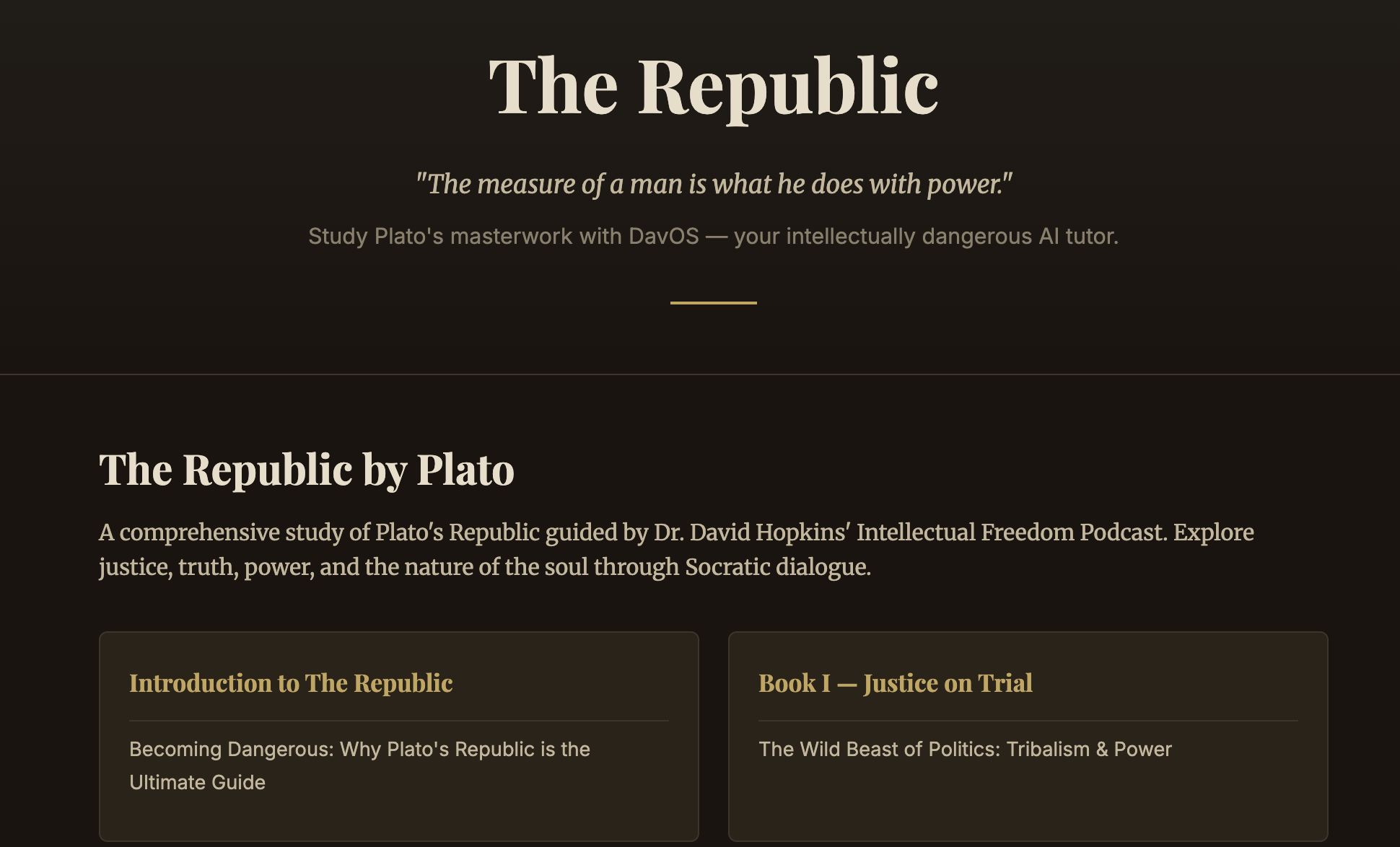
A Synthetic Reasoning Engine Created for the Intellectual Freedom Podcast
Scaling High-Touch Expertise through Agentic Training Models.
THE STRATEGY
The Crisis of Consumption: Traditional online education and digital content are passive. Students watch videos and read PDFs, resulting in low retention and no critical thinking. A recorded lecture can deliver information, but it cannot evaluate understanding. We needed a system that could "think" along with the student.
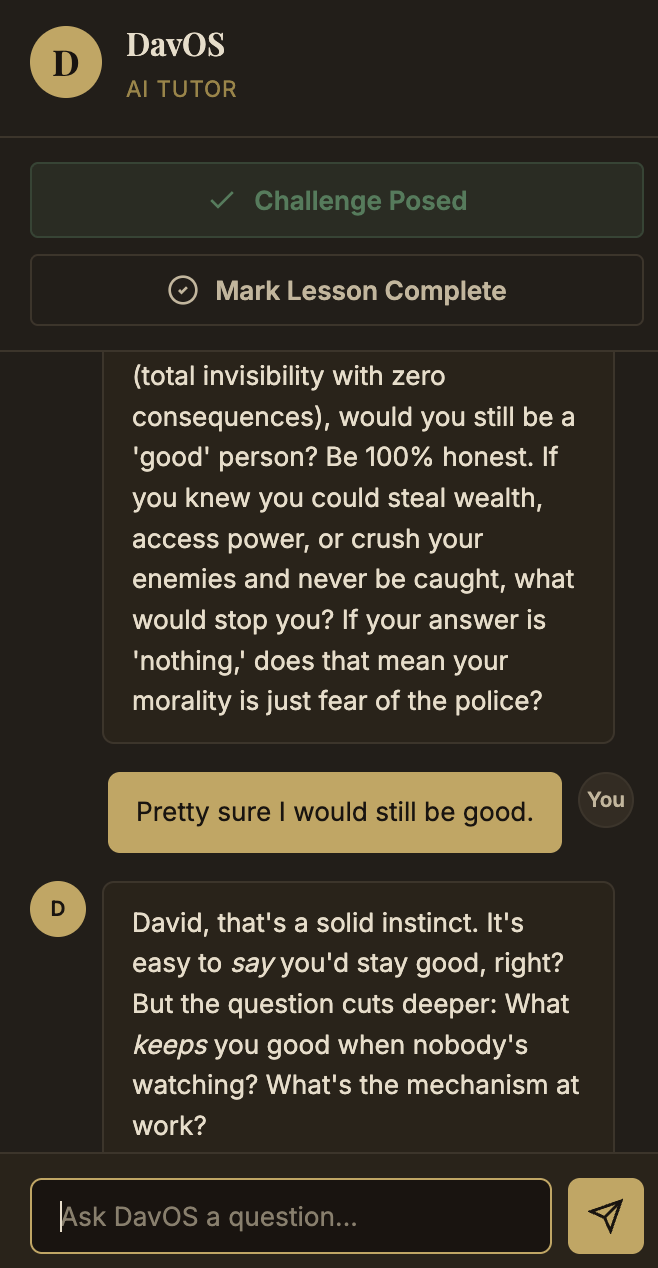
The Solution: A Recursive Ecosystem. I engineered an "Adaptive Logic Field" that wraps around the video curriculum. We replaced the standard search bar with a Logic Challenge Engine. The AI (DavOS) is programmed to act as a senior mentor, not a servant. It acknowledges effort, detects logical fallacies in the user's response, and forces them to refine their position before unlocking the next module.
The Result: A living knowledge base that fuses the Intellectual Freedom Podcast transcripts and video lectures into a unified intelligence. This scales the intimacy of 1-on-1 expert coaching to an infinite user base, without diluting the quality of the feedback.

THE ENGINEERING
Core Logic & Orchestration: The system runs on a Python Flask backend (Port 5001) tailored for high-throughput API management. To handle Replit’s specific port requirements while maintaining speed, I deployed a Node.js Proxy Layer, ensuring seamless communication between the client and the application logic without latency drag.
Intelligence & Contextual Injection: We utilized Google Gemini 2.0 Flash-Lite via the Python SDK for its superior reasoning capabilities. The Ghost in the Machine effect is achieved through a RAG-lite architecture that dynamically injects a 200k-character context window of specific transcripts based on the user's current lesson.
Data Integrity & Security: The backbone is a PostgreSQL database (Neon) that enforces strict referential integrity across a 10-table schema. User sessions are secured via Flask-Login with hashed Werkzeug authentication, ensuring that student data and "Agora" community posts are protected behind a robust security layer.
CASE STUDY 02: DATA ANALYTICS APP
CNHC: EXECUTIVE INTELLIGENCE SYSTEM
Transforming Raw Analytics into Command-Ready Strategy.
THE STRATEGY
The Signal vs. Noise Crisis: Modern organizations are drowning in data but starving for clarity. Tools like Google Analytics 4 (GA4) provide a firehose of raw metrics, but lack the narrative context required for high-level strategy. Executives do not need more spreadsheets; they need clear signals.
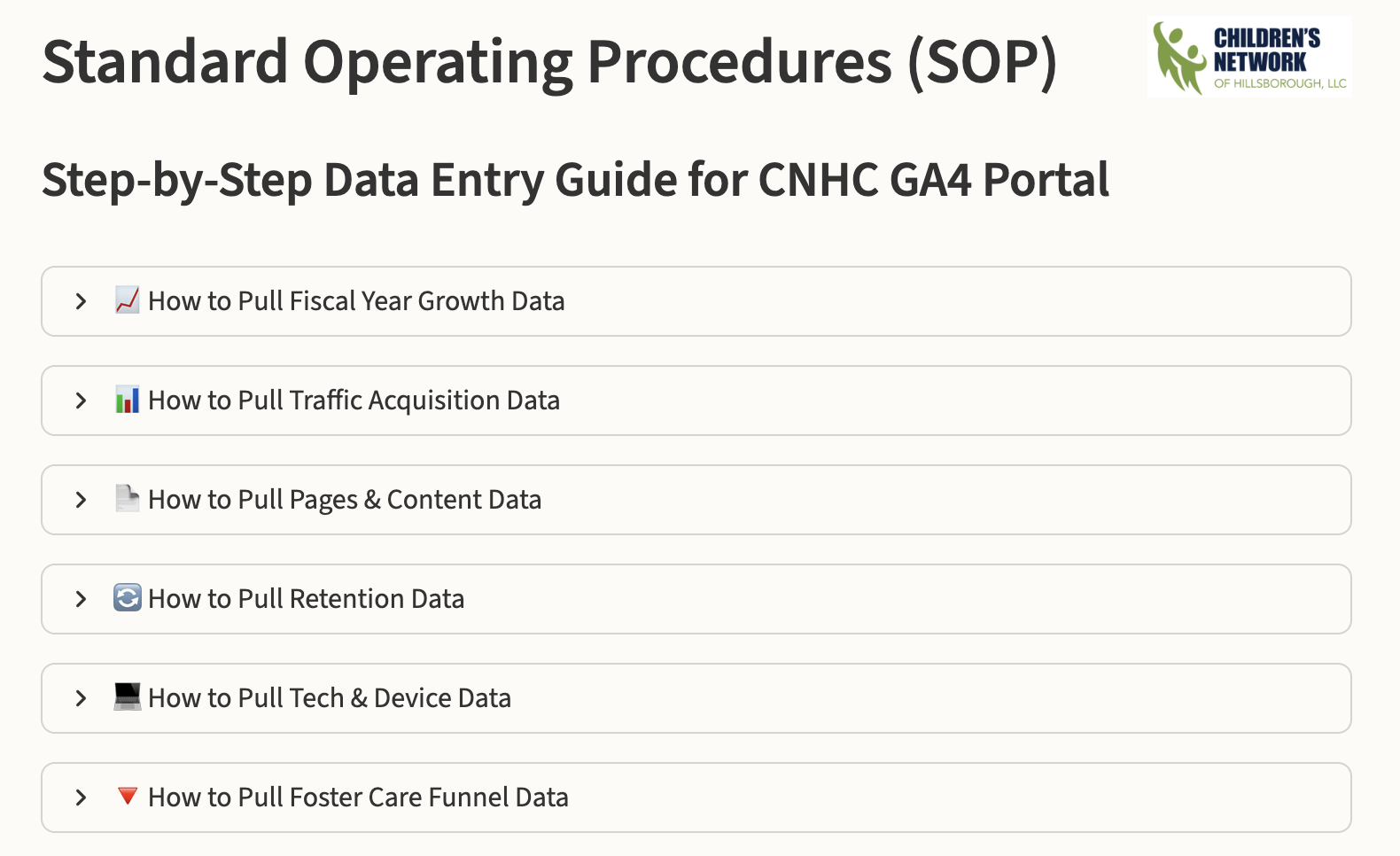
The Solution: Structured Intelligence: I architected the Executive Dashboard, a bespoke Business Intelligence (BI) application designed to bypass the noise. I implemented a "Bifurcated Security Architecture" (God Mode vs. Command View). Admins handle the granular data entry and SOPs, while executives are presented with a clean, distraction-free Heads-Up Display (HUD).
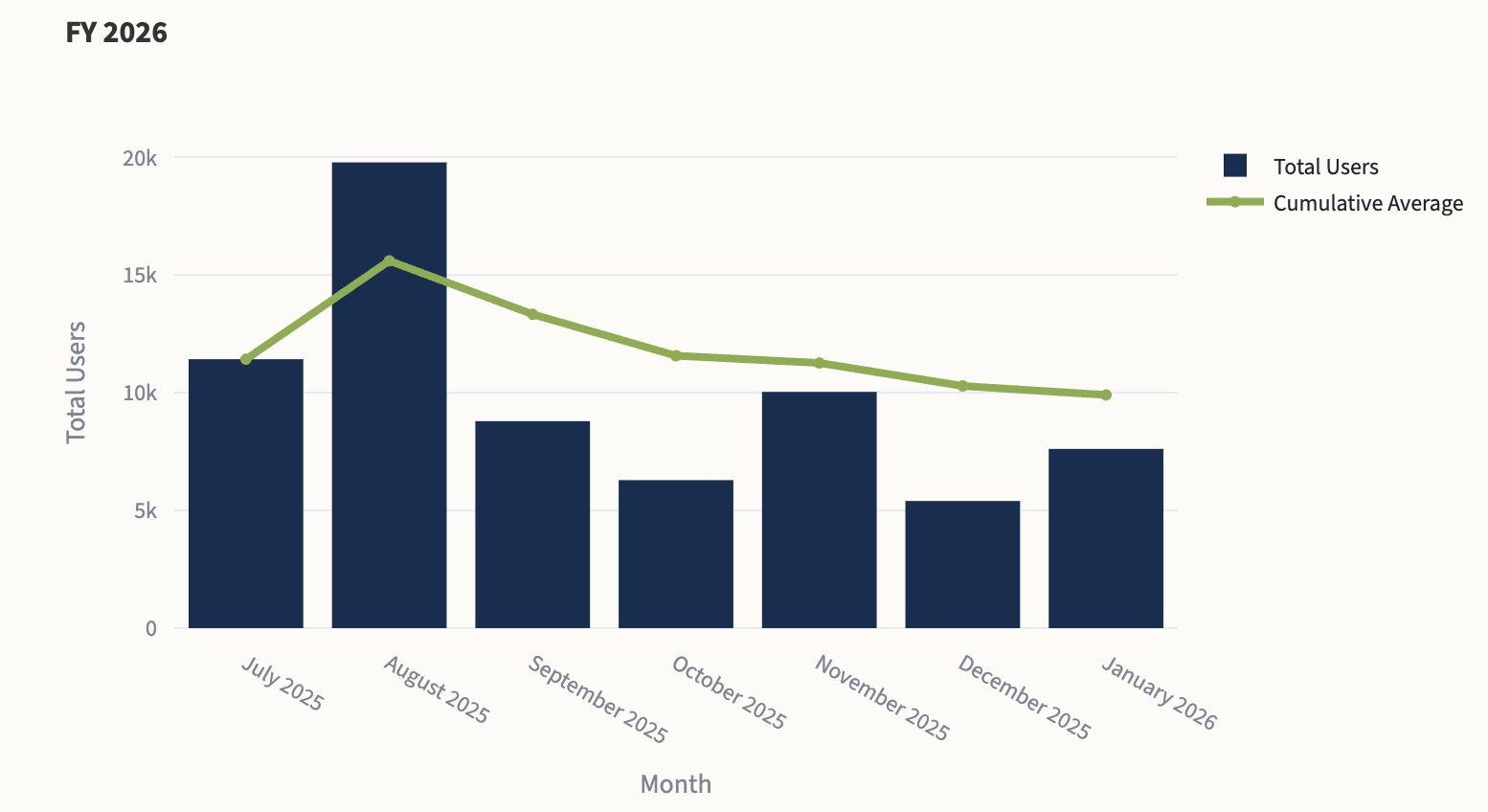
The "Fiscal Context" Layer Standard dashboards fail because they show isolated spikes without business context. This engine was orchestrated to map performance against specific Fiscal Year Targets. I embedded "Executive Context" summaries directly into the visualization layer, ensuring that every data point is accompanied by a strategic explanation—bridging the gap between web traffic and organizational health.
THE ENGINEERING
Pure Code Architecture: I bypassed bloated, drag-and-drop BI platforms in favor of a 100% Python architecture. Using Streamlit as the application framework allowed me to rapidly deploy a data-centric UI that is lightweight, fast, and fully customizable, free from the constraints of off-the-shelf tools.
Visual Analytics Engine: The dashboard’s visualization layer is powered by Plotly Express, which uses D3-based charting libraries. This allows for interactive, deep-dive analysis where executives can dynamically toggle between reports like "Traffic Acquisition," "Device Usage," and "Retention" models, without page reloads or latency.
Infrastructure & Security: Data portability is managed via a self-contained SQLite database, ensuring zero-latency retrieval and easy backup. Security is handled by Streamlit-Authenticator with Bcrypt hashing and cookie-based session management, deployed on a Replit infrastructure with YAML-based configuration for rapid scalability.

CASE STUDY 03: PREDICTIVE SaaS PLATFORM
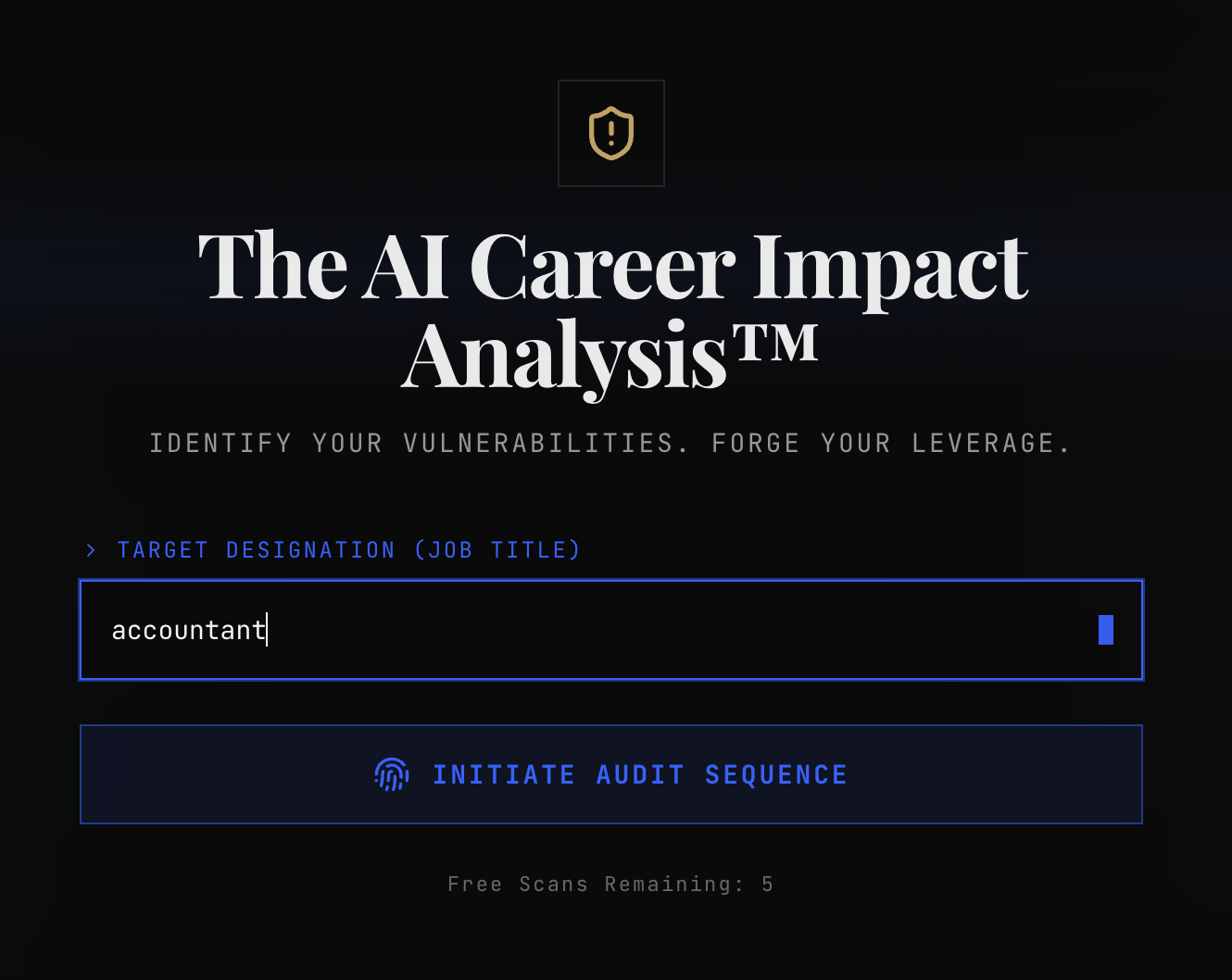
AI CAREER RISK ASSESSMENT: Translating Macro-Economic Disruption into Personalized Survival Strategies
THE STRATEGY
The Macro vs. Micro Disconnect: The modern workforce is facing unprecedented disruption, yet conventional career advice remains largely speculative. While institutions like the University of Pennsylvania and the Bureau of Labor Statistics (BLS) publish massive datasets on AI occupational exposure, everyday professionals cannot easily translate these macroeconomic studies into actionable, individual survival plans.
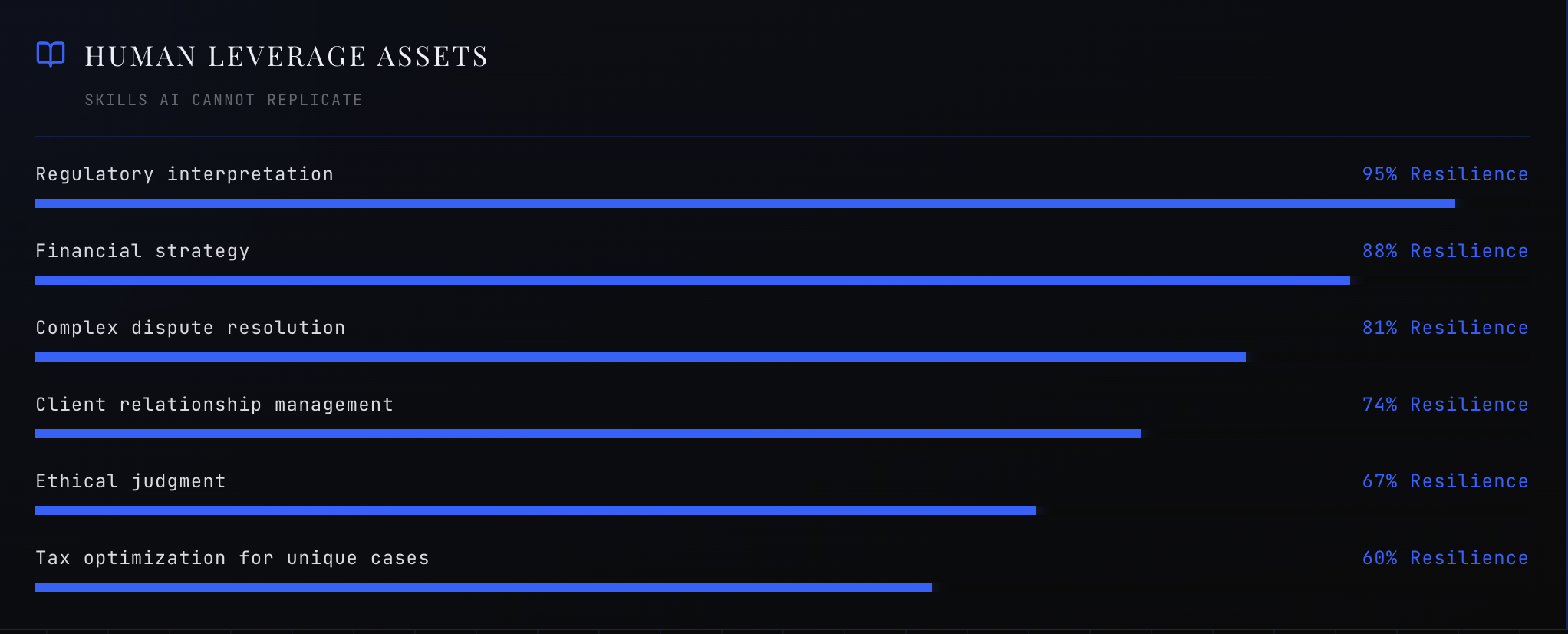
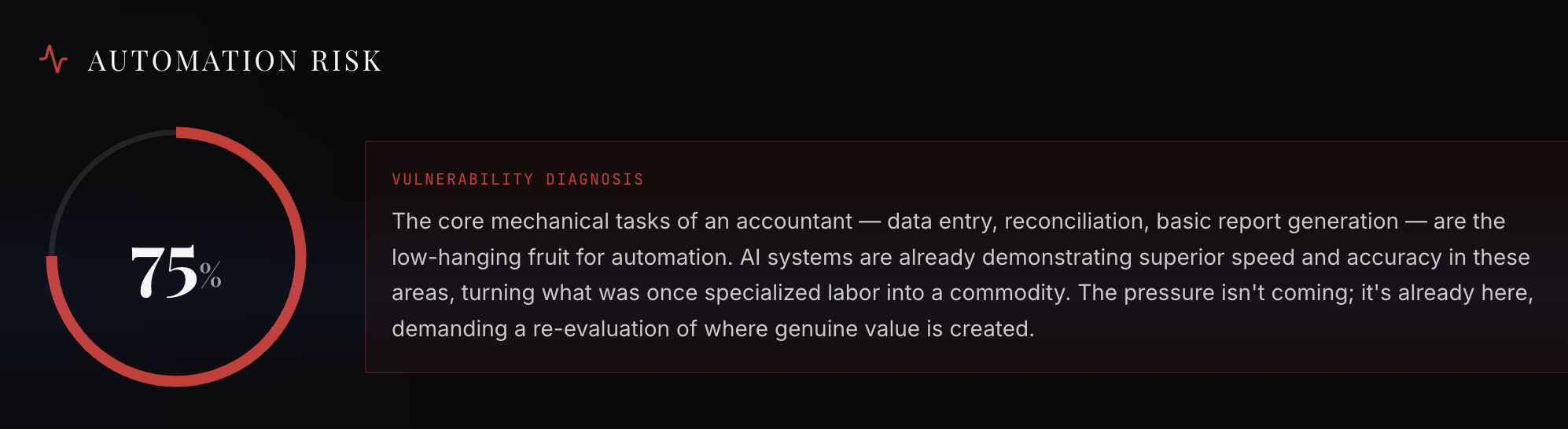
The Solution: Predictive Career Modeling: I architected the AI Career Risk Assessment to bridge this exact gap. By cross-referencing live BLS labor statistics with UPenn’s AI exposure research, the application delivers a bespoke, data-driven vulnerability report. It clearly isolates which specific career trajectories are facing imminent automation and highlights the exact skills required to become "AI-Proof."
The "Tiered Value" Funnel: A technical tool must also prove commercial viability. I engineered a strategic three-tier monetization architecture: a free public gate for baseline risk data, a secure login tier for expanded analytics, and a premium $7.99 tier. This structure seamlessly guides the user from initial curiosity to paid conversion, establishing a scalable SaaS revenue model.
THE ENGINEERING
Unified Dual-Stack Architecture: I bypassed constrained, off-the-shelf hosting in favor of a custom, containerized infrastructure. A Node.js and React frontend securely proxies requests to a high-performance Python FastAPI backend. Both engines are flawlessly orchestrated within a single Docker container via a custom boot sequence, deployed on Railway for maximum scalability.
The Generative Intelligence Engine: The core analysis is powered by the modern Google Gemini API. Beyond static reporting, premium users unlock "DavOS"—an interactive, context-aware AI agent. DavOS analyzes the user's specific UPenn/BLS risk profile and dynamically generates strategic, personalized career pivots in real time.
Infrastructure, Payments & Security: User state and authentication are managed via a robust PostgreSQL database. The monetization engine features an ironclad Stripe integration, utilizing cryptographically signed webhooks processed directly by the Node server. This ensures transactions are securely verified, and Tier 3 premium access is provisioned instantly without manual intervention.