The Great Decoupling: Why Your Career Isn’t Facing a Recession—It’s Facing Extinction
I have spent my academic career studying and teaching the timeline of human civilization. If history teaches us one thing, it is this: true, structural changes to the economy are exceedingly rare.
The printing press didn't just print books faster; it permanently collapsed the scribes' monopoly. The steam engine didn't just speed up manufacturing; it obliterated the artisan guild system forever. These were not temporary "disruptions." They were extinction-level events for the old way of working.
This Is Not a Cycle; It Is a Tectonic Shift
Most generations live and die without ever seeing a tectonic shift of this magnitude. With the age of artificial intelligence upon us, we are not that lucky. We are living through a tectonic shift right now.
The greatest vulnerability of the modern professional is watching the current layoffs and assuming the market will eventually "bounce back" and absorb them, just like it always has. It won't. This isn't a cyclical downturn. It is the permanent, structural collapse of the legacy workforce.
Nobody knows how long this will take. It may be 3, 5, or even 10 years until the shift is complete; however, make no mistake—the shift is happening.
The Blast Radius: Mapping the Exponential Curve of AI Replacement
If you want to see the blast radius's velocity, stop looking at the news and look at the timeline. Recently The Motley Fool published some alarming numbers on the speed of change:
2023 (1%): AI accounted for just 1% of U.S. job cuts. A statistical footnote. The public was still treating the technology like a party trick.
2024 (2%): Enterprise testing began. The number quietly doubled—a warning sign the market slept through.
2025 (5%): The infrastructure matured. The systems went online. Eyebrows were raised.
February 2026 (10%): We crossed the threshold. One in ten of all U.S. layoffs is now explicitly driven by AI replacement. Jaws are beginning to drop.
This is no longer a slow creep. It is an exponential curve. What happens to the United States Economy when that 10% turns into 25-35%? Is the workforce prepared to adapt and change to new roles and opportunities? The answer right now is a resounding “no.”
The Optimizing-the-Titanic Fallacy
Right now, anxious college graduates and displaced professionals think they are being cutting-edge. They are using AI to perfectly optimize their resumes to beat corporate Applicant Tracking Systems. It is a tragic waste of energy. They are busy fighting for jobs that no longer exist—and more importantly, jobs that will never exist again.
When the mechanical loom was deployed in the 1800s, the hand-weaver didn't just have a bad quarter. Their profession was permanently erased. AI is our mechanical loom. Once the machine takes the job, it isn't coming back.
From Asset to Overhead: The End of the Human Middleman
While legacy workers are busy tweaking their cover letters, Corporate America is aggressively doing the math on exactly how many "human nodes" they can strip out of their org charts and replace with autonomous agents by the end of the year.
The Era of the "Human Middleman" is officially over. If your job simply involves taking information from Point A, applying a predictable set of rules, and moving it to Point B, you are no longer an asset.
You are overhead.
You cannot fight an algorithmic disruption with a traditional job hunt. You cannot guess your way out of a structural collapse. You need to know exactly where you stand in the blast radius.
Architecting the Escape Route: The AI Career Risk Assessment
That is why I stopped just researching the timeline and started architecting the escape route.
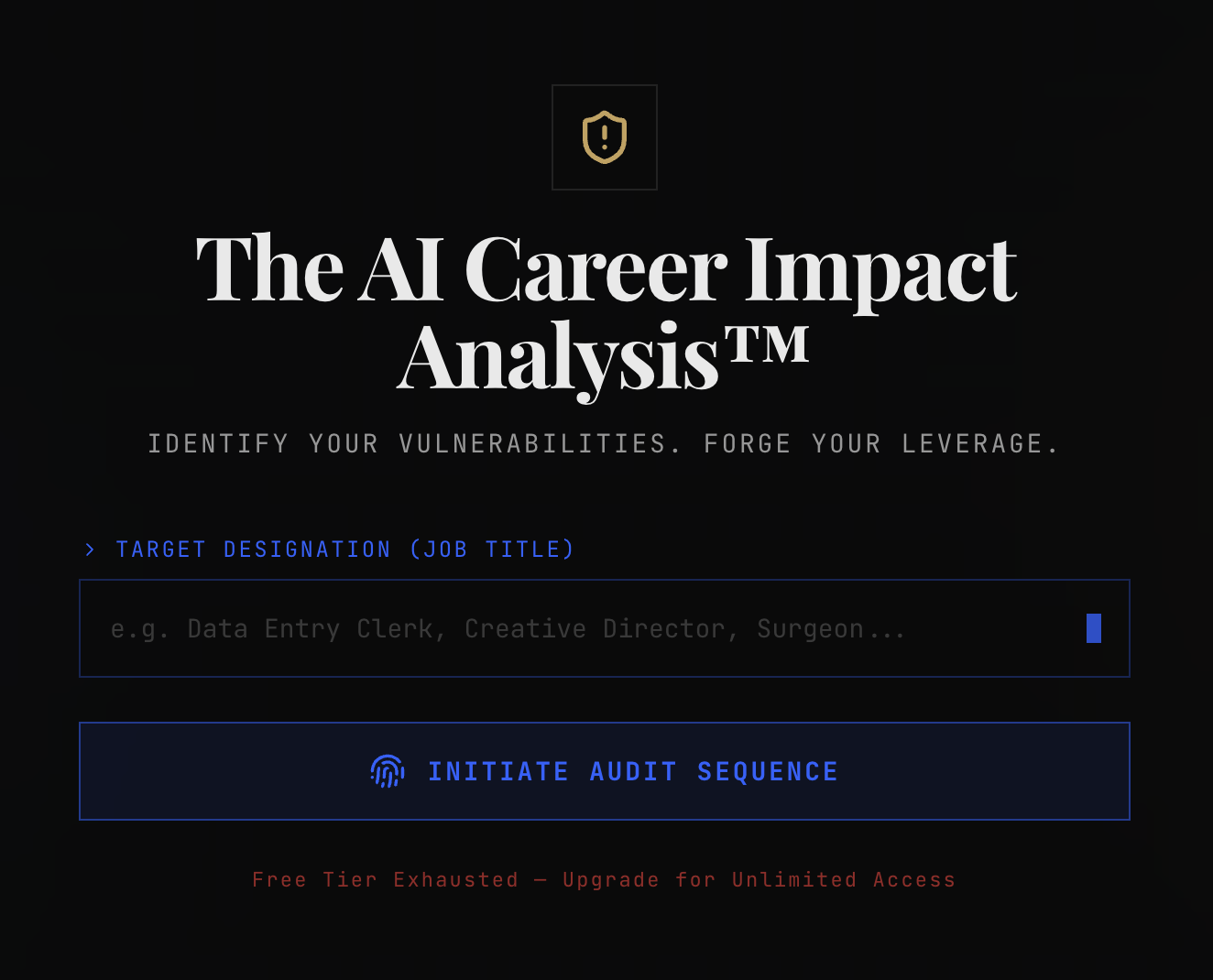
Enter the AI Career Impact Analysis. I built this system to do one thing: strip away the media noise and calculate your exact vulnerability. This is not a personality quiz or a generic career counselor. It is a mathematical audit.
It cross-references your specific career coordinates against the University of Pennsylvania’s landmark research on AI occupational exposure, dynamically merging it with live Bureau of Labor Statistics (BLS) datasets. This isn't speculation; it is a precise, data-driven read on the expiration date of your current trajectory.
Engineering Survival Through Agentic Intelligence
But as an AI Architect, I know that static data isn't enough. I engineered this platform as a fully containerized, dual-stack SaaS infrastructure—a React/Node.js frontend securely proxying to a high-performance Python FastAPI backend, orchestrated via Docker. At the core of this engine is DavOS, an interactive intelligence agent powered by Google's cutting-edge Gemini API. DavOS digests the UPenn and BLS data, mapping it against enterprise automation trends to give you deep, context-aware strategic maneuvers.
I didn't build a glorified PDF or a generic chatbot. I built a private, enterprise-grade engine with two distinct protocols: a free diagnostic to calculate the exact automation threat to your career, and a premium layer that engineers your real-time survival strategy.
The Final Verdict: Legacy Worker vs. AI Director
Let’s be brutally clear about what is actually ending.
If your career is built on memorizing a process, crunching a spreadsheet, or acting as a human router for information, you are a "Legacy Worker." You are paid to follow a formula. And your era is over. The machine does it faster, cheaper, and without a coffee break.
The future belongs entirely to the Director—the human who uses the AI as an engine, but provides the steering wheel of context, empathy, and strategy.
Stop guessing which side of the line you are on.
I have removed the paywall on the AI Career Risk Assessment because you cannot build an escape route without knowing the terrain. You need to see the raw data of your exposure before we can engineer your survival.
The math costs you nothing. Ignorance will cost you everything. Run the initial audit for free! Let’s build the map. Just click on the AI Career Impact Analysis.